
Traditions · Senegal · 6 min read
Kankurang: The Guardian of the Grove
Story · 6 min read
Spoken reading of this record. Original community recordings are released only with the knowledge holders' consent.
The Story
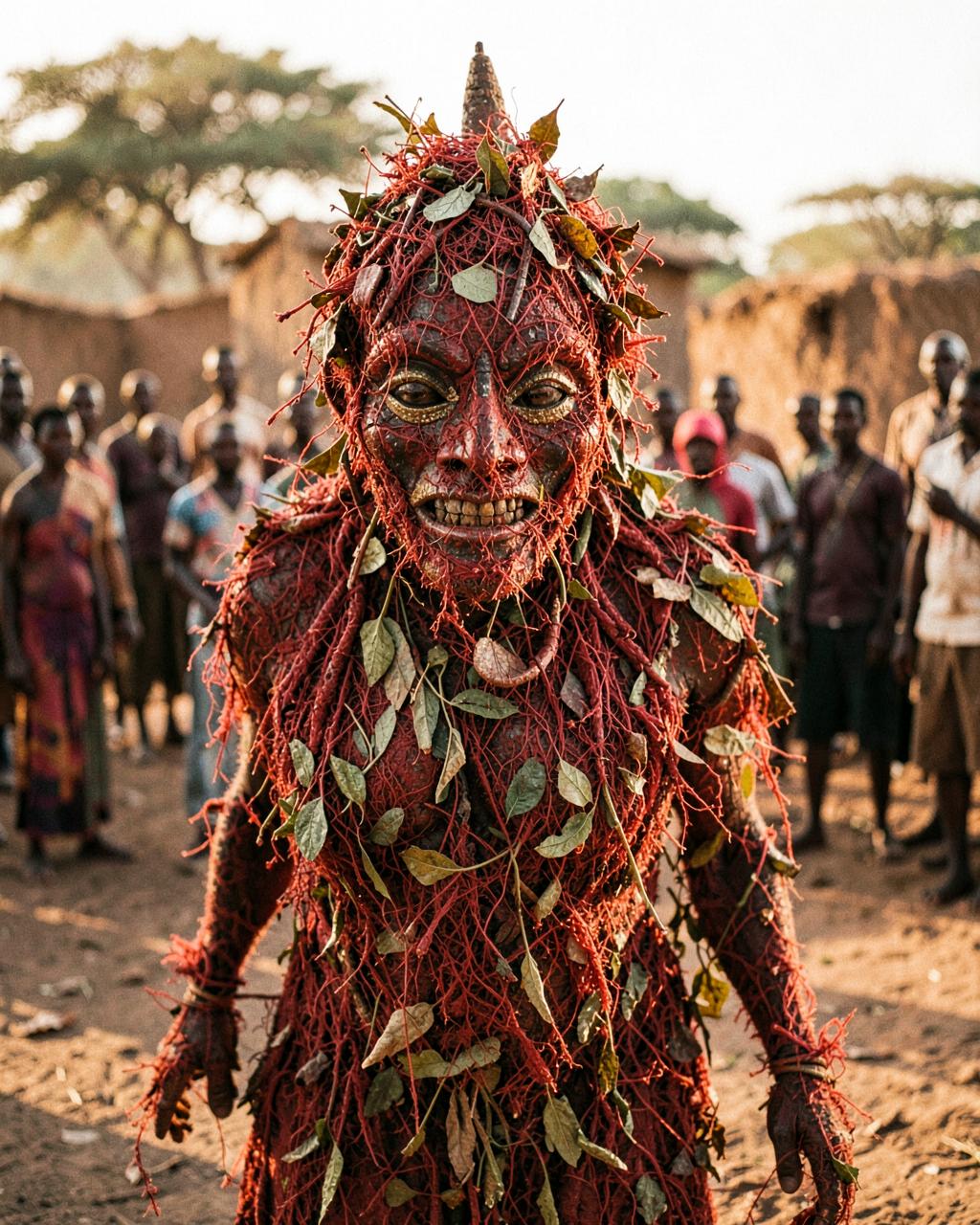
In Mandinka towns across southern Senegal and The Gambia, there are weeks of the year when a figure covered in red faara bark and green leaves moves through the streets, carrying two machetes and a voice that everyone recognises before they see it.
This is the Kankurang. He appears during the initiation of boys, and his role is protective rather than decorative. He accompanies the initiates, keeps the circumcision grove safe, and enforces order in the neighbourhood while the initiation lasts.
The figure and his grove
The Kankurang is worn by a man chosen from within the initiation structure, and his identity is not discussed openly. He moves with a group of young men who sing, drum and clear the path ahead of him. Children scatter and return, which is part of the theatre as well as part of the teaching.
During the same period, elders pass on knowledge that is not written down: how plants are used, how disputes are settled, what respect looks like in practice, and what a man is expected to carry for his family.
A tradition that crosses a border
Because Mandinka families live on both sides of the Senegal–Gambia border, the Kankurang belongs to the whole Senegambian region rather than to one country. Households in Ziguinchor, Mbour, Brikama and Basse recognise the same figure, with local differences in dress, timing and song.
Why it is protected
UNESCO inscribed the Kankurang, or Manding initiatory rite, on its lists of intangible cultural heritage in 2005 and 2008. The listing records both its importance and its fragility: urban growth, shorter initiation periods and the loss of sacred groves have all changed how the rite is practised.
What we are recording next
Our Senegal collection begins with families who hold Kankurang knowledge and with the women who prepare food, songs and welcome for returning initiates — a part of the rite that is often left out of written accounts.
Editorial note
Editorial note: this record is written from public heritage documentation rather than from a single recorded interview. Practices, meanings and names vary between communities, so descriptions here are held as one telling among many. Knowledge holders from this community are invited to correct, expand or replace this entry.
Cultural Context
An initiation tradition. Some knowledge connected to the grove is restricted and is not published here.
Contributor: Her African Culture editorial team, from UNESCO and Senegalese cultural documentation.
Associated place: Casamance, Senegal
Language: Mandinka, Wolof, French · Consent: Granted · Verification: Human verified