Traditions · The Gambia · 6 min read
Basket Weaving in The Gambia: The Craft That Holds Everything
The Story
Before a Gambian basket is a basket, it is a field.
It begins with palm fronds cut and split into strips, with grasses gathered and dried in the sun, and sometimes with recycled plastic strapping or fabric worked in beside the natural fibre. The material is softened, sorted by thickness, and only then does the weaving start.
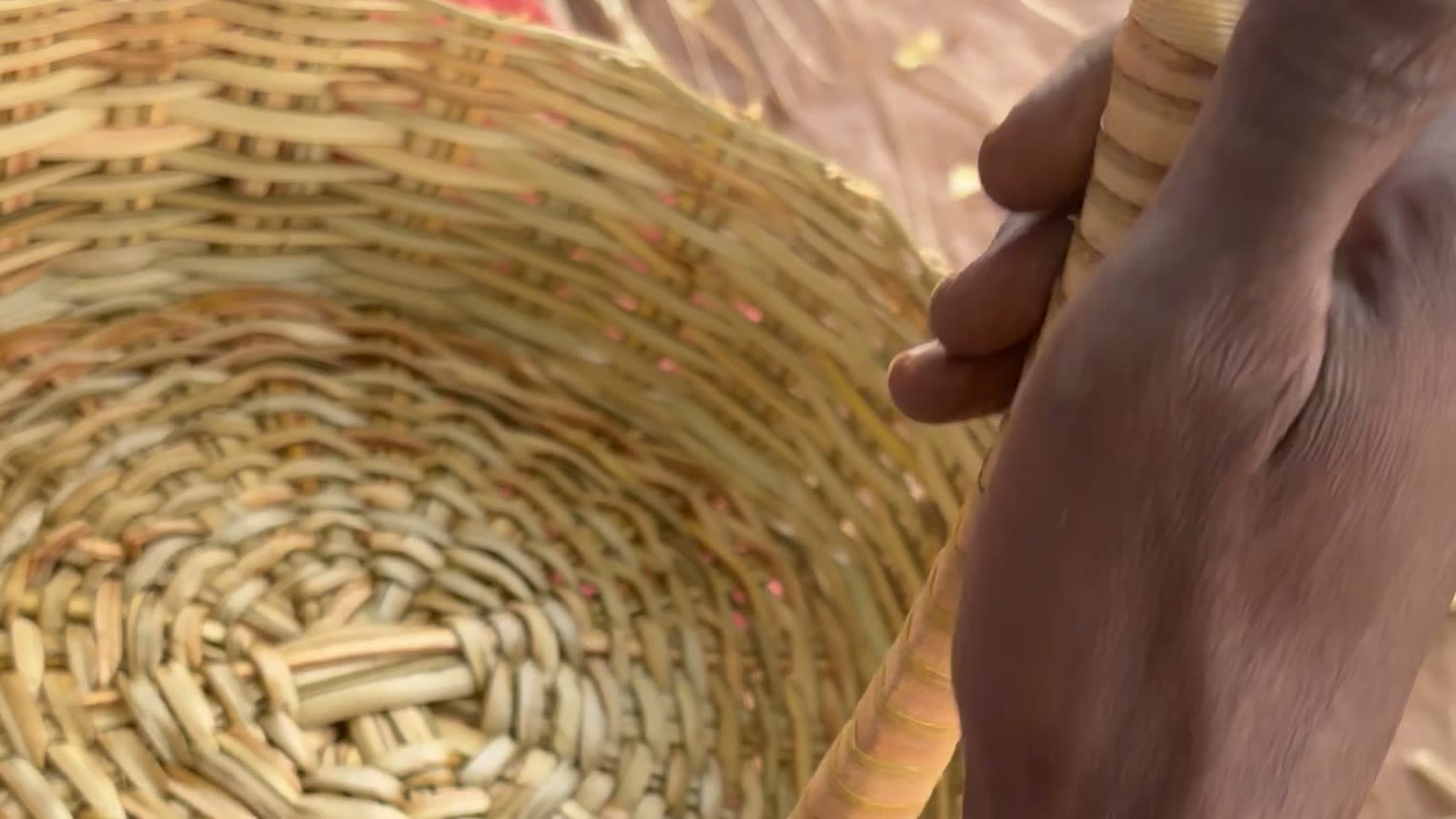
In this short film, a weaver works a coil around the rim of a basket, binding the frame with a strip pulled tight on every turn. There is no machine in the frame. There is no pattern drawn on paper. The measurement lives in the hands.
A craft made for daily life
Basket weaving in The Gambia has never been decoration first. Baskets carry rice from the field and fish from the landing site. They hold groundnuts during shelling, fruit on the head to market, laundry across the compound, bread from the bitik in the morning. Wide flat trays are used for winnowing grain, letting the wind take the chaff. Lidded baskets store cloth and keepsakes.
Because the work is functional, the shapes are practical: the deep market basket with a bound handle, the shallow fanner, the round storage bowl, the tall grain container. Each shape answers a task, and each region has its own preferences of weave, dye and finish.
Who weaves, and how the knowledge moves
Weaving is often household knowledge. In many communities women weave grass and palm-leaf baskets and mats, while men are more often associated with heavier cane and rattan furniture work — although this varies by community and by family, and the boundaries have shifted over time.
The learning is not formal. Children sit beside an aunt, a mother or a grandmother, first sorting strips, then attempting a base, then failing, then trying again. A weaver can usually tell who taught someone by looking at the tension of their coil.
This is what makes the craft an inheritance rather than an industry. The technique is carried through the body, from one pair of hands to the next.
Colour, pattern and meaning
Traditional Gambian baskets are often left in the warm straw tones of the fibre itself, with the pattern created by the rhythm of the weave. Others are dyed in strong bands of colour and finished with leather-bound rims, particularly baskets made for markets and for visitors.
Pattern is rarely random. Weavers speak of the sequence of a piece — how many turns before a colour changes, how the rim is closed, how a handle is bound so it will not loosen when the basket is loaded. These choices are how a maker signs their work without writing a name on it.
The economics of a basket
For many households, weaving is income. Baskets are sold at craft markets in Banjul, Serrekunda, Bakau and Tanji, along the coastal tourism strip, and increasingly through export and online craft trade. A single well-made market basket may take a day or more of work once the fibre has been prepared.
That value is fragile. Imported plastic containers are cheaper and faster to produce, and younger people often leave for other work. At the same time, global interest in handmade natural-fibre goods has given Gambian weaving a new market, which raises its own questions about fair pricing and who benefits from the sale.
Why we are recording it
A basket is easy to overlook. It sits in a corner of the kitchen, it gets carried to the market, it wears out and is replaced. It is not treated as heritage while it is still being used.
But the technique in this video is the same technique that has moved rice, groundnuts and fish across this country for generations. It is knowledge with no manual, held only in the people who still practise it.
That is why we film the hands, not only the finished object. The basket is the result. The weaving is the record.
Editorial note
Basket weaving is documented here as a living everyday craft. Materials, shapes, patterns and the division of work vary between communities, regions and families, and this record presents that variation rather than a single definitive account.
Cultural Context
Basket weaving is one of the most widely practised traditional crafts in The Gambia, using palm leaf, locally gathered grasses, cane and, in contemporary work, recycled materials. Baskets are made for agriculture, food processing, storage, transport and trade, and the craft functions simultaneously as household knowledge, women's work in many communities, and a source of income through local markets and craft export.
Contributor: Her African Culture
Associated place: Weaving households and craft markets across The Gambia
Language: Mandinka, Wolof, Fula, English · Consent: Granted · Verification: Human verified